

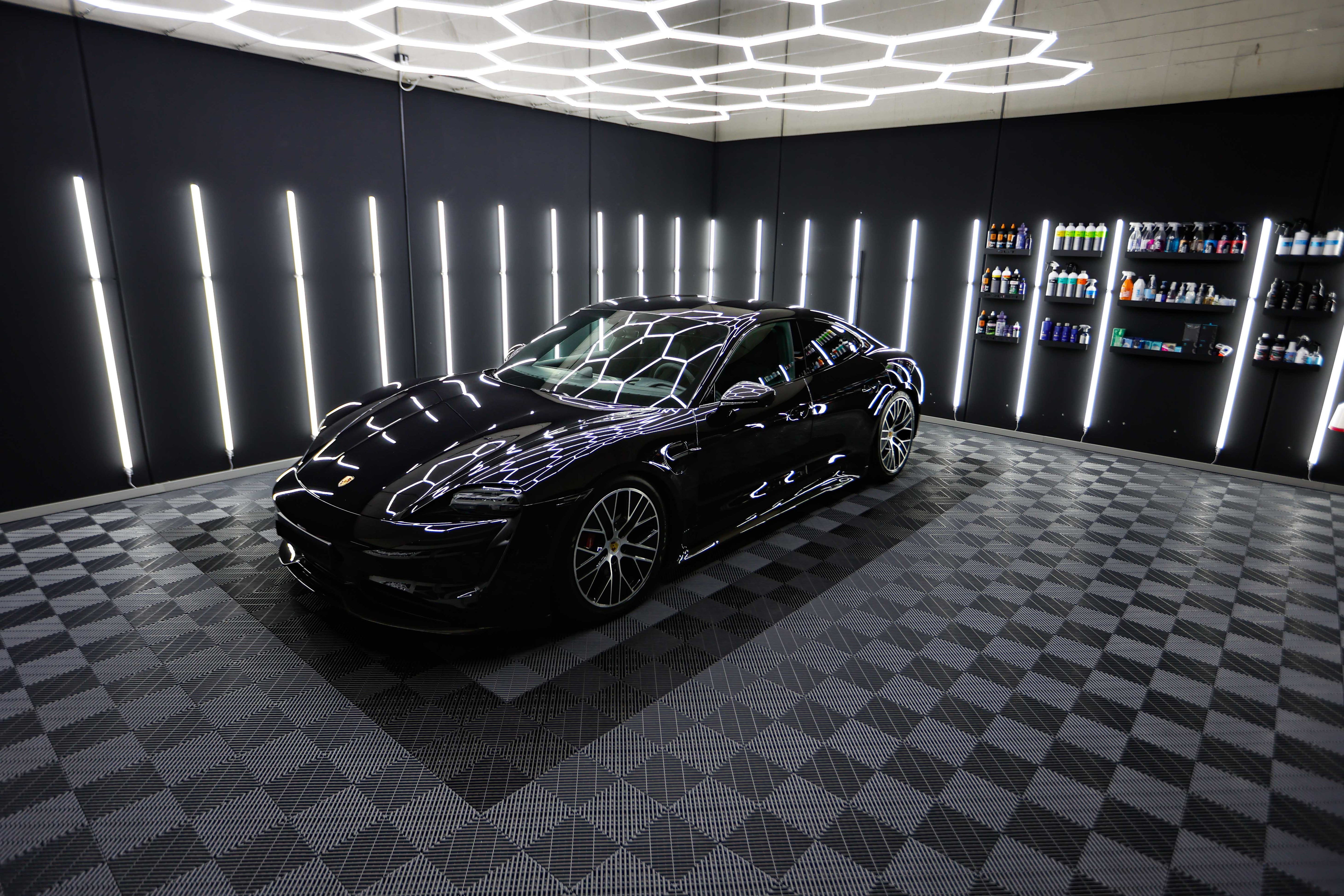
If you've ever watched videos from top-tier detailing studios on social media, you've noticed a pattern: the car isn't just lit, it's enveloped in light. This is a light tunnel.
With Ledex lighting solutions, this effect is no longer an unattainable luxury, but a technical necessity for every serious professional. In this post, we'll explain why vertical lighting is critical and how it will change your workflow.
Why isn't ceiling lighting enough?
A typical mistake is to install powerful lighting only on the ceiling. But you can't fight physics – light falls from above, leaving the areas below the car's side mirrors (doors, sills, bumpers) in semi-shadow.
-
Distorted perspective: Horizontal light does not reveal deep scratches or "spider webs" on door panels.
-
Fatigue: Constant bending and searching for angles with a flashlight tires the eyes and slows down work.
Vertical light: LED posts and wall panels
Ledex vertical solutions create a uniform light flow from floor to roof. This is the "moment of truth" for every polisher.
1. Ceramic coating "haze" and "high spots"
When applying a ceramic protective layer, the biggest risk is leaving the product unevenly on the surface (so-called high spots). Vertical light reflects along the side of the car, instantly making these unevennesses visible. You no longer have to sway your head back and forth to find the right angle.
2. Lower panels and wheels
The lower third of the car is usually the most damaged area. Ledex wall lights illuminate sills and wheels so you can see every ding and tar spot without crawling on the ground.
Technical depth: Why choose the Ledex system?
In a professional environment, not only light matters, but also the durability of the equipment:
-
Color temperature stability: Ledex LED elements maintain a stable 6500K level throughout their lifespan. With cheap strips, the light starts to "float" towards yellowish or bluish over time, which compromises color recognition.
-
Eye-friendly diffusion: Our lights have a special milky cover that diffuses light softly. This means you don't see sharp LED points on the paint, but clear and clean light lines. This significantly reduces eye strain during long polishing sessions.
How to build a light tunnel in your studio?
For optimal results, we recommend the following configuration:
-
Ceiling: Ledex Hexagon (main light and general work area).
-
Walls: Vertical LED strips or lower-positioned Hexagon sections.
-
Angle: The light should fall on the car's surface at approximately a 45-degree angle to create maximum contrast for finding defects.
Summary
A light tunnel isn't just for "Instagram pictures" – it's the best investment in work quality. If you want customers to say "Wow!" when they pick up their car, you need to see what others don't.
Why isn't ceiling lighting enough? Light falls from above and leaves the areas below the side mirrors – doors, sills, bumpers – in semi-shadow.
At what angle should light fall on the car's surface? Approximately 45 degrees – this creates maximum contrast, which helps to see defects better.
Why is color temperature stability important? Ledex LED elements maintain a stable 6500K level throughout their lifespan, while cheaper strips drift towards yellowish or bluish over time and compromise the accuracy of color recognition.
Explore Ledex lighting solutions and build your dream studio today.
See also: Modular Flooring: Why a Ventilated Solution Beats Concrete →
Jaga:
Ledex Hexagon Anatomy: what makes a detailing light truly good?
Ventilated modular flooring: more than design